
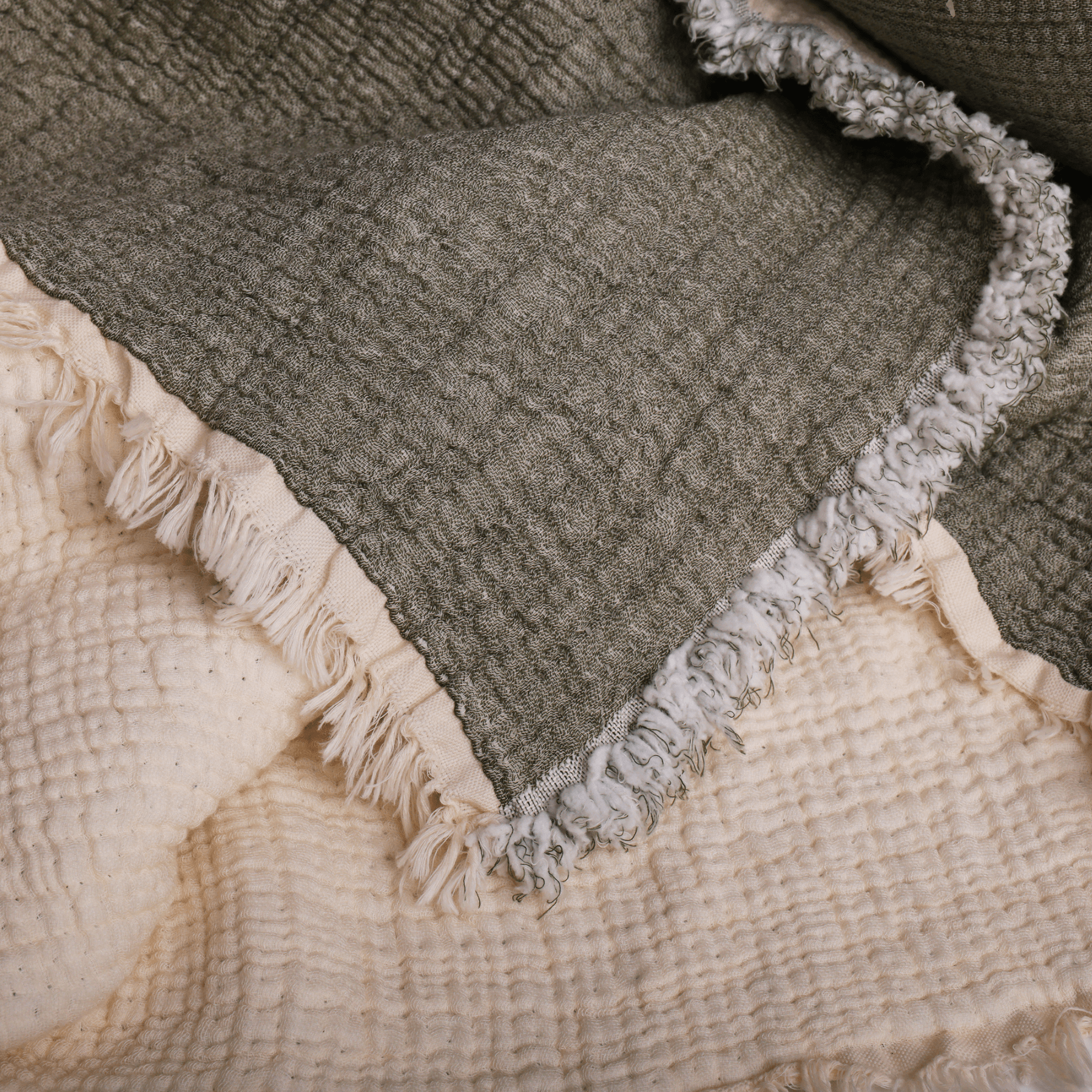
Fabric selection in home textiles directly affects the daily performance of a product. How much water a towel absorbs, how quickly a beach towel dries, how warm a blanket keeps you, or how a cover used on a sofa looks is largely related to the fabric structure.
Therefore, when choosing, it is not enough to look only at color, pattern, or thickness. The fiber structure, weaving type, softness, absorbency, and care needs of the fabric should be evaluated together. Choosing the right fabric helps make the product more comfortable and usable for a long time. The wrong choice, on the other hand, may lead to problems such as hardening, pilling, slow drying, or discomfort during use over time.
The right fabric is not always the thickest fabric. What really matters is that the product is made from a material suitable for its intended use. Absorbency may be a priority for the bathroom, lightness for the beach, taking up little space for travel, and warmth for winter use.
What Are the Main Fabric Types Used in Home Textiles?
Cotton, Turkish cotton, linen, bamboo, microfiber, wool, acrylic, and polyester-blend fabrics are most commonly used in home textiles. Each fabric has a different area where it performs best. Therefore, it would not be right to see a single fabric as the best option for all products.
Natural fibers such as cotton, linen, bamboo, and wool may provide a softer and more comfortable feel in products that come into contact with the skin. Cotton towels, Turkish towels, bathrobes, and duvet covers are frequently preferred for this reason. Synthetic fibers such as microfiber, polyester, and acrylic may offer advantages in terms of lightness, quick drying, wrinkle resistance, and easy care.
The distinction between natural and synthetic alone is not enough to make a decision. What matters is where, how often, and with what expectation the product will be used. Absorbency in the bathroom, quick drying at the beach, lightness during travel, and shape retention in decorative use may be more determining factors.
|
Fabric Type |
Best Area of Use |
Key Feature |
Point to Consider |
|
Cotton |
Towel, bathrobe, duvet cover |
Soft, absorbent, breathable |
Low-quality cotton may pill over time |
|
Turkish cotton |
Turkish towel, peshtemal, beach towel |
Lightweight, durable, dries quickly |
Its texture may settle better after the first washes |
|
Linen |
Summer cover, duvet cover, table textiles |
Cool, natural, durable |
Can wrinkle easily |
|
Bamboo |
Towel, baby textiles, sensitive-skin products |
Soft, good moisture balance |
Blend ratio should be checked |
|
Microfiber |
Sports, travel, beach |
Dries very quickly, takes up little space |
May not provide a natural cotton feel |
|
Wool |
Blanket, sofa throw |
Keeps warm, long-lasting |
Care may be more delicate |
|
Acrylic |
Decorative blanket, cover |
Lightweight, retains its shape |
Breathability may be limited |
|
Polyester blend |
Cover, decorative product |
Durable, dries easily |
Absorbency may be low |
The weaving structure affects product performance as much as the fabric type. Terry woven towels offer a fluffy and absorbent structure. Flat-woven peshtemals provide a thinner, lighter, and quick-drying use. Waffle weave, thanks to its air channels, dries quickly and creates a modern look.
How Does Fabric Structure Affect Comfort of Use?
The structure of the fabric determines not only the appearance of the product but also how it feels during use. Two products made from the same material may show different performance due to different weaving techniques. Therefore, along with fabric content, weaving type, fabric weight, fiber length, and surface texture should also be considered.
In a cotton towel, a long-staple structure may provide a more durable and softer use. Short-staple cotton, on the other hand, may show pilling or hardening over time. This becomes more noticeable especially in frequently washed products such as towels, bathrobes, and sheets.
Terry weave creates a full and absorbent structure in towels. For this reason, it can be a comfortable option for bathroom use. Waffle weave, on the other hand, is preferred for bathroom, spa, travel, and summer use because it offers a lighter, breathable, and quick-drying experience.
Flat-woven peshtemals and Turkish towels stand out with their lightweight structure. Since they take up little space in the bag and dry quickly, they provide practicality in areas such as the beach, hammam, sauna, and travel. If a denser and fluffier towel feel is desired, classic bath towels may be more suitable.
Fabric weight is also important in the selection process. Higher-weight products may provide a fuller and more substantial feel; however, they may not be ideal for every area of use. For example, while a full towel provides comfort in the bathroom, the same product may dry slowly and be difficult to carry at the beach. Therefore, the intended use of the product should definitely be considered when evaluating fabric weight.
How to Choose the Right Fabric According to Area of Use?
To choose the right fabric, it should be clear where the product will be used. Absorbency in the bathroom, quick drying at the beach, lightness during travel, warmth in winter products, and texture and shape retention in decorative use come to the forefront.
Cotton, Turkish cotton, and bamboo are good options for the bathroom. These fabrics provide advantages in terms of softness, absorbency, and comfort in contact with the skin. In products such as towels and bathrobes, fabrics that can withstand frequent washing should be preferred.
For the beach, Turkish towels, peshtemals, and microfiber products are more practical. Thanks to their lightweight structure, they take up less space in the bag. Their quick-drying properties also help reduce the risk of damp odors after use.
For travel, thin, lightweight fabrics that take up little space can be preferred. Peshtemals, Turkish towels, and microfiber products are useful in this respect. The same products can also be used as a beach towel, shawl, picnic blanket, or travel blanket.
For winter use, wool, thick cotton textures, and quality fabric blends stand out. In these products, warmth, softness, and long-term shape retention are important. In products such as blankets and sofa throws, making sure that the texture does not irritate the skin is also an important point to consider.
For decorative use, linen, cotton covers, acrylic, and polyester-blend products can be preferred. In this area, not only the feel of the fabric but also color harmony, texture, drape, and compatibility with the area of use are important. In the living room, bedroom, or table textiles, the fabric is expected to create visual harmony with the space it is in.
For sensitive skin, rough-textured or heavily synthetic fabrics may create discomfort over time. In such cases, turning to products made from cotton, bamboo blends, or soft natural fibers may be a more comfortable choice.
How Should Natural and Synthetic Fabrics Be Evaluated in Home Textiles?
In home textiles, natural fabrics generally stand out in terms of softness, breathability, and comfort in contact with the skin. Cotton, linen, bamboo, and wool are included in this group. These fabrics may offer comfortable use especially in products such as towels, duvet covers, bathrobes, baby textiles, and blankets.
Synthetic fabrics, on the other hand, may provide advantages in terms of lightness, quick drying, wrinkle resistance, and easy care. For this reason, microfiber, acrylic, and polyester-blend products can be considered for sports, travel, beach, and decorative use.
What matters here is not to see natural fabrics as always better and synthetic fabrics as always weaker. Each fabric has a different area where it performs best. For example, while a cotton towel provides comfort in the bathroom, a microfiber towel may be more practical during travel. Linen offers a fresh use in summer, while wool becomes a stronger option in winter products.
In blended fabrics, attention should be paid to the ratios. Cotton, bamboo, polyester, or acrylic blends can change the texture, absorbency, durability, and care needs of the product. Therefore, when choosing a product, it is healthier to evaluate not only the fabric name but also the content ratio and intended use together.
The first touch is also not enough on its own when choosing fabric. Some products may feel very soft in the store or during first use; however, they may lose their form after a few washes. Therefore, care instructions, weaving quality, and frequency of use should also be included in the selection process.
How Should Fabric Care Be Done in Home Textiles?
Proper care is important for the fabric to look good for a long time and maintain its usage performance. Incorrect washing, excessive detergent, high heat, and heavy use of fabric softener can weaken the fiber structure. This may cause loss of absorbency in towels, hardening in sheets, and deformation in blankets and covers.
For cotton products, warm washing and a delicate program can generally be preferred. Excessive fabric softener should not be used to preserve the absorbency of towels. Fabric softener can reduce water absorption performance by coating the surface of the fibers.
In linen products, natural wrinkling is one of the characteristic features of the fabric. Therefore, more controlled care should be preferred instead of drying at very high heat or using harsh spin programs. For wool products, care instructions should be followed more carefully and high heat should be avoided.
The use of fabric softener in microfiber products may negatively affect performance. For these types of fabrics, low-temperature washing and proper rinsing are more suitable. In acrylic and polyester-blend products, excessively hot drying is not recommended in order to preserve the form.
The following points can be considered during care:
-
Wash similar colors together.
-
Check the washing instructions on the product label.
-
Do not overfill the machine.
-
Do not wash towels together with clothes that have zippers and buttons.
-
Avoid excessive detergent and heavy use of fabric softener.
-
Do not prefer very high heat during drying.
-
Place products in the closet only when they are completely dry.
Especially towels, peshtemals, bathrobes, and thick-textured covers may be prone to retaining moisture. Therefore, it is important to dry them in an open area after use. Products folded while damp may have an increased risk of odor and mold formation.
Frequently Asked Questions About Fabric in Home Textiles (FAQ)
What does fabric weight mean in home textiles?
Fabric weight refers to the weight of the fabric per square meter. In products such as towels, as fabric weight increases, the product generally becomes fuller and more absorbent. However, higher weight does not always mean better. For beach and travel use, lighter-weight products may be more practical.
What is the difference between a Turkish towel and a classic towel?
A Turkish towel generally has a thinner, lighter, and quick-drying structure. Classic towels, on the other hand, may be thicker and fluffier. While a Turkish towel provides practicality for beach, hammam, and travel use, a classic towel can be preferred by those who want more intense absorbency in the bathroom.
Should home textile products be washed before first use?
Yes. Products that come into contact with the skin, especially towels, bathrobes, duvet covers, and peshtemals, are recommended to be washed before first use. The first wash can help remove dust left from production and help the fabric show better absorbency.
Why do towels become hard over time?
Towels generally become hard due to excessive detergent, heavy fabric softener use, drying at high heat, or insufficient rinsing. Using less detergent, limiting fabric softener, and not exposing towels to very high heat help the fabric remain softer.
Which fabric is more advantageous when choosing a beach towel?
For a beach towel, lightweight, quick-drying fabrics that take up little space in the bag are more advantageous. Turkish cotton, peshtemal weaves, and microfiber stand out for this use. Cotton Turkish towels offer a natural feel, while microfiber products may provide faster drying performance.
Share:
What Should You Buy as a Housewarming Gift?
Father's Day Gift Ideas: What to Buy for Every Dad