
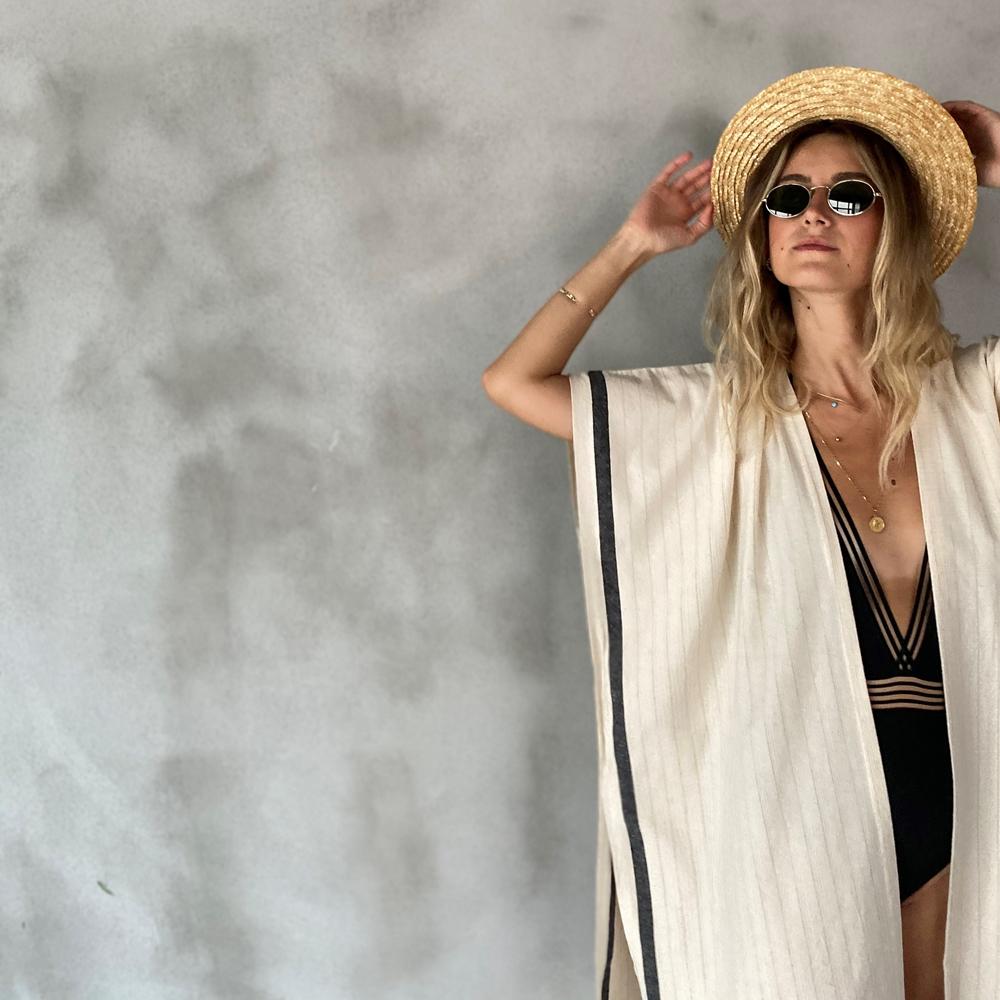
Kimono, kaftan, and beach cover-up are among the garments most commonly confused with one another during the summer months. Although they may seem similar at first glance, they are actually not the same in terms of area of use, cut, and the overall impression they create. For this reason, choosing the right piece should not be based only on appearance, but also on what the item is designed to be used for.
This distinction becomes especially important when preparing for a summer vacation. A piece that will be worn at the beach may not offer the same comfort when used at home, on vacation, or in everyday outfits. Some items can be put on quickly and are practical for stepping out of the sea, while others present a more polished and elegant look. That is why understanding the difference between a kimono, kaftan, and beach cover-up makes it much easier to choose the right piece in terms of both style and use.
Where Does the Difference Between a Kimono, Kaftan, and Beach Cover-Up Begin?
The difference between these three pieces appears most clearly in their cut, purpose of use, and style feel. All of them can be lightweight and all can be preferred in summer. However, the way they sit on the body and their usage scenarios set them apart from one another.
A kimono generally has a more structured appearance and a more open-front design. A kaftan, on the other hand, has a more flowing and comfortable silhouette. A beach cover-up is usually designed for practical use at the beach, pool, or after swimming. For this reason, when making a choice, one question should be answered: Where will this piece be used the most?
The table below shows the general differences more clearly:
|
Type of Garment |
Standout Feature |
Area of Use |
Overall Appearance |
|
More open-front structure and a more defined form |
Homewear, vacation, daily outfits, beachwear |
More polished and balanced |
|
|
Kaftan |
Flowing structure and comfortable freedom of movement |
Vacation, homewear, after swimming |
More fluid and relaxed |
|
Beach Cover-Up |
Lightweight and quick to use |
Beach, pool, resort areas |
More practical and function-oriented |
What Is the Difference Between a Kimono and a Kaftan?
The difference between a kimono and a kaftan is felt most clearly in their form. A kimono generally has an open front, a more defined structure, and a layered look that creates a frame around the outfit worn underneath. In this sense, it acts more like an outer layer that completes the piece worn underneath. For this reason, it should not be seen only as beachwear, but also as a comfortable style element in everyday wear.
A kaftan, on the other hand, has a freer silhouette. It usually sits more loosely on the body and has a more fluid appearance. Its sense of a single-piece garment is stronger. For this reason, especially in hot weather, it may be more suitable for those who prioritize comfort with less clinging to the body. If you want a layer that feels relaxed but still looks more put-together, a kimono offers a more balanced choice.
In short, while a kimono works more as a complementary piece, a kaftan can be a garment that creates a complete look on its own.
What Is the Difference Between a Kimono and a Beach Cover-Up?
The most obvious difference between a kimono and a beach cover-up lies in how the two pieces are designed. Both can be worn over swimwear. However, not every kimono is a beach cover-up, and not every beach cover-up looks like a kimono.
A kimono is generally a more versatile piece. It can be used after the beach, but it can also comfortably be included in everyday outfits. Especially when made from fabrics suitable for summer, it becomes useful both at home and outdoors. A beach cover-up, by contrast, responds more directly to a beach-related need. Its basic purpose is to add a light layer over a swimsuit or bikini. Its being quick to put on, lightweight, and easy to carry is more important here.
For this reason, when choosing a beach cover-up, practicality stands out as much as aesthetics. When choosing a kimono, the area of use should be considered more broadly. For those heading from the beach to a café, or who want a piece that extends from home to outdoor use, a kimono may be a stronger option.
What Is the Difference Between a Kaftan and a Beach Cover-Up?
There is also a similar closeness between a kaftan and a beach cover-up. Both are summer, lightweight, and comfortable pieces. However, a kaftan is generally thought of as a garment with a stronger sense of a complete look. A beach cover-up, by contrast, provides more direct coverage and ease of throwing on.
A kaftan offers a more fluid silhouette and can be more naturally worn not only in holiday settings, but also in summer homes or during moments of relaxation after the beach. A beach cover-up is more direct, simpler, and more minimal in structure. The aim is not to create a full outfit effect, but to provide a comfortable outer layer.
If you want a gentle balance between elegance and comfort, a kaftan may stand out. If your priority is simply functional use at the beach, a beach cover-up may be the better choice.
What Should the Fabrics of Kimono, Kaftan, and Beach Cover-Up Be Like?
When choosing between these three pieces, the fabric is at least as important as the cut. In summer clothing, one of the most important factors that determines comfort is the lightness and breathability of the fabric. Very thick fabrics can feel overwhelming in hot weather. Surfaces that feel overly synthetic can also reduce comfort.
The most preferred fabric qualities for these items are:
-
a lightweight and breathable structure
-
a surface that feels soft against the skin
-
a form that is easy to carry and fold
-
a fluid drape suitable for summer use
-
the advantage of quick drying or easy care
Muslin, fine cotton textures, and lightweight natural fiber blends are especially popular in this category. If the item is intended for post-beach use, lightness becomes even more important. For home and everyday use, however, not only lightness but also the visual appearance of the fabric becomes a deciding factor.
What Should You Pay Attention to When Choosing a Kimono, Kaftan, or Beach Cover-Up?
When deciding between these three pieces, it is more important to look at the usage scenario than the product name itself. Sometimes similar cuts may be presented under different names. For a more accurate choice, you can pay attention to the following points:
-
Determine where you will use the piece most often
-
Check whether the cut has an open front or is a single-piece design
-
Make sure the fabric is light and breathable
-
Evaluate whether the level of transparency is suitable for its intended use
-
Make sure the length and sleeve structure do not restrict your range of movement
One common mistake is choosing the item based only on the photo. However, the same product may be very practical at the beach but insufficient for everyday use. Or a piece that looks very stylish may not feel comfortable in hot weather. That is why you should look not only at how it appears, but also at how well it will accompany your lifestyle and needs.
Which Is More Suitable: Kimono, Kaftan, or Beach Cover-Up?
The answer depends entirely on your usage habits. If you are looking for a piece that you can use at home, on vacation, and for short outings, a kimono may be the more versatile option. If you want something more relaxed, flowy, and airy, a kaftan may suit you better. If you are simply looking for a lightweight layer for the beach or poolside, a beach cover-up will be the more functional choice.
The best choice is less about which piece looks better and more about which one fits your lifestyle more naturally. When you evaluate the area of use, the fabric structure, and the cut together, making a decision becomes much easier.
Although the difference between a kimono, kaftan, and beach cover-up may seem small, it becomes quite noticeable in actual use. A kimono is more structured and multi-purpose. A kaftan is more fluid and comfortable. A beach cover-up, on the other hand, offers practicality around the beach and pool. That is why, when making a choice, it is important to focus not only on the name or appearance, but also on the environment in which the piece will accompany you.
The right piece is not just the one that looks good, but the one you feel comfortable in and genuinely use. Once you understand this distinction, making a choice becomes much easier.
Frequently Asked Questions About the Difference Between Kimono, Kaftan, and Beach Cover-Up (FAQ)
Can a kimono be worn in everyday outfits?
Yes, a kimono can easily be worn in everyday outfits. Especially lightweight models with simple designs can be paired effortlessly over basic combinations. In this sense, it can be used not only at the beach, but also at home and as part of daily wear.
Is a kaftan only suitable for the beach?
No, a kaftan is not a piece used only for the beach. Thanks to its comfortable structure, it can also be preferred as homewear, on vacation, or on summer evenings. Its area of use may vary depending on the fabric and cut.
Can a beach cover-up be worn without a swimsuit?
It can be worn, but its main purpose is to add a light layer over a swimsuit or bikini. For this reason, some models may be too thin or too sheer for everyday use. When choosing one, the fabric and level of coverage should be taken into consideration.
Is Size Important When Choosing a Kimono, Kaftan, or Beach Cover-Up?
Yes, size is important for these products as well. Even though a relaxed fit is often preferred, factors such as shoulder structure, garment length, and sleeve shape affect overall comfort. Choices that are too oversized or too tight can especially change how the piece sits and looks on the body.
Which Fabrics Are More Suitable for a Kimono, Kaftan, or Beach Cover-Up?
During the summer months, fabrics that are lightweight, breathable, and soft against the skin are more suitable. Muslin, fine cotton textures, and lightweight natural fiber blends offer a more comfortable wearing experience for these pieces.
Share:
What Is a Bathrobe Used For?
What Should You Buy as a Housewarming Gift?