
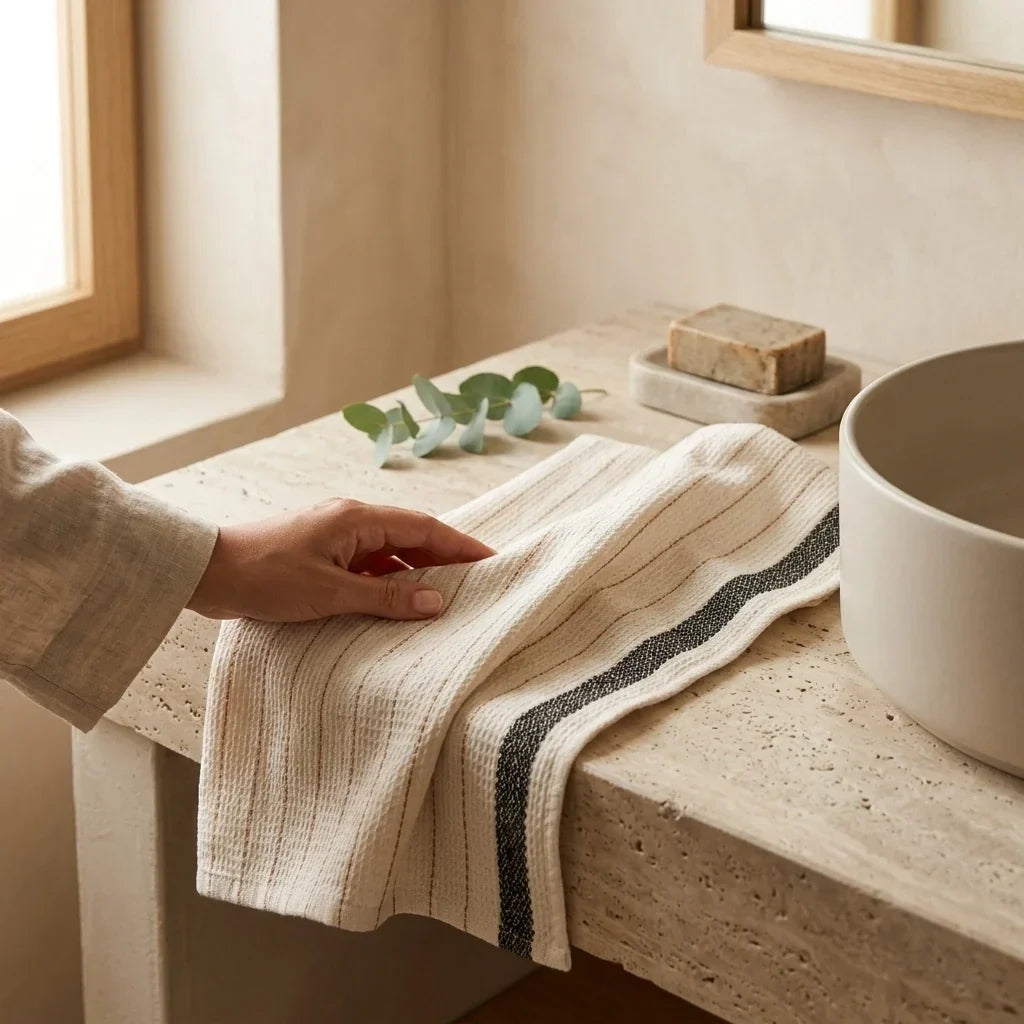
Organic cotton towels are woven from cotton grown without synthetic pesticides, synthetic fertilizers or genetically modified seed. The difference begins in the field, not at the loom.
Farming is only half of the definition. Certified organic production also limits which dyes, bleaches and softening agents may touch the fabric during processing.
The result is a towel with a shorter chemical history than a conventional one. How much of that difference is verifiable depends entirely on the certification behind the label.
Organic Cotton vs Regular Cotton: What's the Difference?
The difference lies in how the fiber is farmed and processed, not in how the towel is woven. Both start as cotton and both can be woven into the same terry or flat-woven structure.
Conventional cotton is one of the most pesticide-intensive crops in commercial agriculture. Organic farming replaces those inputs with crop rotation, cover crops and mechanical weed control.
|
Feature |
Organic cotton |
Conventional cotton |
|---|---|---|
|
Seed |
Non-GMO seed only |
Often genetically modified |
|
Field inputs |
No synthetic pesticides or fertilizers |
Synthetic pesticides and fertilizers permitted |
|
Processing chemistry |
Restricted dyes, no chlorine bleach or formaldehyde finishes |
Broad range of dyes and finishes permitted |
|
Traceability |
Documented through certification |
Rarely documented |
|
Price |
Typically 20-40% higher |
Lower |
Fiber quality is a separate question. Staple length, the length of the individual cotton fiber, decides softness and durability. It depends on the cotton variety and growing region rather than on organic status.
What Are the Benefits of Organic Cotton Towels?
The main benefits are a cleaner chemical profile, a lighter farming footprint and, in certified supply chains, documented working conditions.
Absorbency is the most practical of these. Conventional towels are often finished with silicone softeners that make the fabric feel plush in the store but repel water for the first several washes. Certified organic finishing rules restrict those coatings.
Durability follows from fiber choice rather than farming method. Long-staple varieties such as the cotton used in Turkish bath towels survive repeated washing with less shedding and thinning.
The environmental case is real but narrower than marketing usually suggests. Organic farming removes synthetic pesticide inputs from the soil and groundwater around the field. Yields per hectare are generally lower, so land use rises.
Organic Cotton vs Bamboo Towels: Which Is More Sustainable?
Neither fiber is automatically more sustainable. The deciding factor is how the raw plant is turned into yarn.
Bamboo grows quickly, regenerates from its own root system and usually needs no irrigation or pesticides. On the farming side, its footprint is genuinely small.
Processing is where the picture changes. Most textiles labelled bamboo are viscose or rayon, produced by dissolving the plant in sodium hydroxide and carbon disulfide. Closed-loop lyocell processing recovers most of those solvents, but it is more expensive and less common.
Lifespan matters as much as inputs. Bamboo viscose loses strength when wet and tends to thin sooner than cotton under heavy bathroom use. A towel replaced every two years carries a larger total footprint than one replaced every eight.
For buyers comparing sustainable towels, the useful question is not cotton or bamboo. It is whether the processing route and the expected lifespan are documented at all.
What Certifications Should You Look for in Organic Towels?
GOTS is the strongest signal, because it certifies the fiber and the processing behind it. The other common labels each cover a narrower slice.
-
GOTS (Global Organic Textile Standard): Covers the full supply chain from farming to finished product. The "organic" label requires at least 95% certified organic fiber, and "made with organic" requires at least 70%. It also sets wastewater and labor criteria.
-
OCS (Organic Content Standard): Verifies how much organic fiber a product contains and traces it back through the chain. It says nothing about processing chemistry or working conditions.
-
OEKO-TEX Standard 100: Tests the finished article for harmful substances, including formaldehyde, heavy metals and restricted azo dyes. It applies to any fiber and does not confirm organic origin.
-
Made in Green by OEKO-TEX: Adds audited production facilities to that testing, with a traceable product ID.
Every certificate carries a number that can be checked in the issuing body's public database. This step is worth taking, because a supplier may hold a certificate covering only the yarn, not the finished towel.
OEKO-TEX certified towels and GOTS certified towels answer different questions. One confirms that nothing harmful remains in the fabric, the other confirms how the cotton was grown and processed.
How to Choose the Best Organic Cotton Towel for Your Home
Weight, weave and drying conditions decide the right towel more than price does. The first number to check is GSM, or grams per square meter, which describes fabric density.
Flat-woven towels in the 300-400 GSM range are light, quick to dry and easy to fold into a small cupboard. They suit humid bathrooms and small households, where a heavy towel rarely dries fully between uses.
Terry towels between 500 and 700 GSM feel plush and hold more water. Where a spa-like weight matters more than drying speed, the denser options among luxury bath towels are the better match.
Size is worth checking against the label rather than the photograph. A standard bath towel measures roughly 70x140 cm, while a bath sheet runs closer to 90x170 cm.
Colour also carries a small practical difference. Undyed and low-dye natural cotton towels avoid the dye transfer that darker shades can cause in the first few washes.
How to Care for Organic Cotton Towels to Extend Their Life
Washing habits determine most of a towel's lifespan, not the fiber itself. Organic cotton has no protective finish to fall back on, so the routine matters more.
-
First Wash: A wash before first use removes loom residue and opens the fibers, which improves absorbency from the start.
-
Fabric Softener: Softeners leave a waxy coating across the loops that repels water. Half a cup of white vinegar in the rinse softens the fabric without that effect.
-
Wash Temperature: Warm water around 40 degrees cleans effectively without weakening the fiber. Hot cycles accelerate shrinkage and fading.
-
Load Size: Towels need room to tumble. An overloaded drum leaves detergent trapped in the pile, which stiffens the fabric over time.
-
Drying: Low heat and wool dryer balls preserve the loops. Shaking each towel before it goes in restores loft.
-
Snagged Loops: A pulled loop is cut level with the surface rather than tugged, which would draw a whole row of the weave loose.
Organic cotton towels ask for a modest premium and slightly more attention at the laundry stage. What they return is a fabric with a documented history, from seed to finished edge. For something that touches skin every day, that traceability is often the deciding argument.
Frequently Asked Questions About Organic Cotton Towels
Is Turkish cotton the same as organic cotton?
No. Turkish cotton describes origin and fiber length, since the region is known for long-staple varieties that produce soft, absorbent yarn. Organic describes the farming method. A towel can be Turkish and organic, one of the two, or neither, so both claims need checking separately.
Are organic cotton towels actually better for your skin?
For most people the everyday difference is small. Organic certification restricts formaldehyde finishes, chlorine bleach and certain dyes, so fewer residues remain in the fabric. That may matter for skin that reacts easily to textile finishes. A certificate covering the finished towel is the only reliable indicator.
What is OEKO-TEX certification and why does it matter for towels?
OEKO-TEX Standard 100 tests a finished textile for more than a hundred harmful substances, including heavy metals and restricted dyes. It matters for towels because they sit against damp skin daily, which increases contact with anything left in the fabric. It does not verify organic farming.
Do organic cotton towels feel different from regular ones?
Often yes, at least initially. Conventional towels frequently carry a silicone softening finish that feels plush in the shop and washes out within a few cycles. Organic cotton arrives without that coating, so it can feel firmer at first and softens gradually across the first washes.
How can you tell if a towel is truly organic?
Only a certificate confirms it. The label should name the standard, such as GOTS, and carry a licence number that can be checked in that body's public database. Wording like "eco", "pure" or "100% natural" carries no verified meaning and is not regulated in most markets.
Share:
How to Create a Spa Day at Home
What Is a Turkish Cotton Robe?