
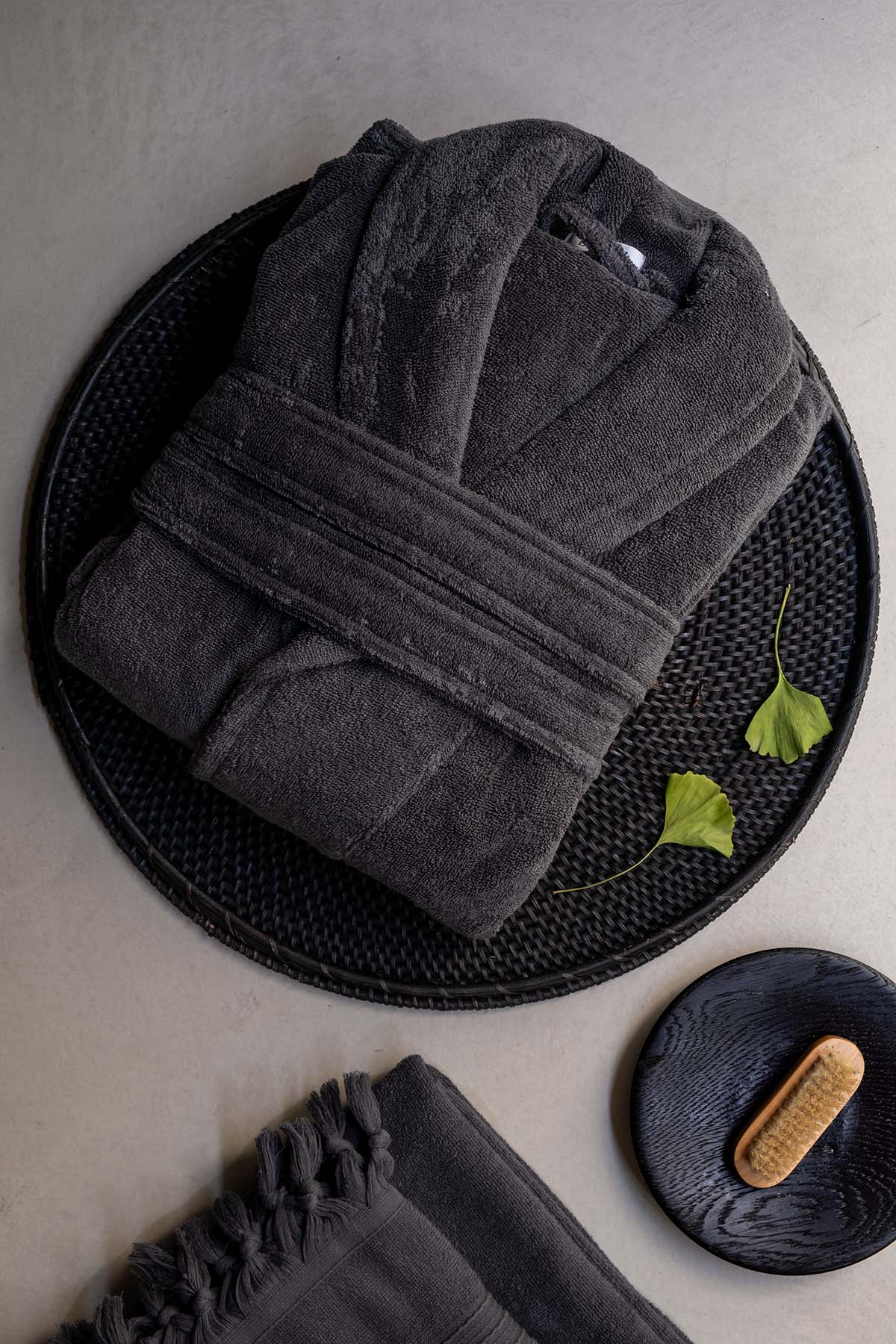
A Turkish cotton robe is a robe woven from long-staple cotton grown and milled in Turkey. The weave is usually flat, waffle-textured or multi-layer gauze rather than dense terry pile.
That construction is what separates the garment from a standard bathrobe. The fabric absorbs water without trapping much of it, so it dries in a few hours instead of a full day.
The result is a robe light enough for summer mornings and warm enough for a cool bathroom. It also folds down small, which matters for both storage and travel.
Turkish Cotton Robe vs Regular Bathrobe: Key Differences
The difference sits in the weave. A regular bathrobe is built from looped terry pile, while a Turkish robe is usually flat-woven, waffled or layered gauze.
Those loops are what make a terry bathrobe feel plush in the first minute and heavy in the tenth. A flat weave carries far less water, so the garment stays light against the shoulders.
|
Feature |
Turkish cotton robe |
Regular terry bathrobe |
|---|---|---|
|
Weave |
Flat, waffle or gauze |
Looped terry pile |
|
Weight |
Roughly 250-400 GSM |
Roughly 400-600 GSM |
|
Drying time |
A few hours |
Often a full day |
|
Packed size |
Folds flat and small |
Bulky |
|
Best season |
All year |
Cold months |
|
Feel over time |
Softens with each wash |
Loses loft as loops flatten |
Fiber quality explains the rest. Staple length, meaning the length of a single cotton fiber, decides how smoothly the yarn spins and how little it sheds.
Long-staple cotton produces fewer loose fiber ends. That is why a well-made turkish robe pills less and holds its surface for years of regular washing.
What Are the Different Styles of Turkish Cotton Robes?
Four constructions cover almost the entire category, and each one behaves differently after a shower.
-
Flat-Woven Peshtemal: The lightest option, descended from the woven cloth used in traditional hammams. It dries fastest and packs smallest, though it offers the least warmth.
-
Waffle Weave: A honeycomb structure that traps a thin layer of air. It balances absorbency and drying speed, which suits year-round bathroom use.
-
Multi-Layer Gauze: Several layers of loosely woven muslin stitched together. The air between the layers creates warmth at a very low weight, and the fabric grows softer with every wash.
-
Terry-Sided Or Shawl Collar: A hybrid with terry on the inner face and a flat weave outside. It absorbs like a classic bathrobe while staying lighter overall.
Cut matters as much as weave. Lightweight kimono shapes sit between loungewear and outerwear, which is why the same piece often appears among beach cover-ups rather than only in the bathroom.
The Benefits of a Turkish Cotton Robe for Everyday Comfort
The practical benefit is that the fabric dries between uses. A robe that never stays damp resists the musty smell that develops in heavy terry.
Temperature regulation follows from the same structure. Air moves through a flat or gauze weave, so the robe feels comfortable in August and still holds warmth in November.
Weight is the difference most people notice first. A wet terry bathrobe can carry a kilogram of water across the shoulders, while a flat-woven one carries a fraction of that.
Softness improves rather than fades. Because these fabrics are not finished with silicone softeners, they start slightly crisp and relax over the first several washes.
Storage is the quiet advantage. Lightweight robes fold to about half the bulk of a terry equivalent, which frees a shelf in a small bathroom.
Turkish Cotton Kimono Robe vs Classic Robe: Which Is Better?
Neither shape wins outright. The kimono suits lounging, travel and warm weather, while the classic collared robe suits drying off after a bath.
A kimono cut has straight sleeves, an open front and a waist tie, with no collar bulk at the neck. Most are sold in a one-size shape that drapes rather than fits.
A four-layer muslin design such as the Joy Kimono Robe shows the type clearly, with a relaxed body, a snug waist tie and hidden side pockets.
A classic robe adds a shawl collar and closer sleeves. The collar holds heat around the neck and shoulders, which is the main reason it feels warmer at the same fabric weight.
Sleeve shape decides the rest. Wide kimono sleeves stay dry while washing dishes or drying hair, whereas fitted cuffs sit closer and keep more heat in.
How to Choose the Right Turkish Cotton Robe for You
The right robe follows from where it will be worn most: the bathroom, the sofa or a suitcase. Each location favours a different weave.
For a turkish bath robe used straight out of the shower, waffle or terry-sided fabric is the safer choice. Both move water off skin quickly without becoming heavy.
For lounging and reading, multi-layer gauze is more comfortable. It behaves like a blanket at a fraction of the weight and does not overheat indoors.
Length changes the character of the garment. A knee-length cut moves easily and dries faster, while mid-calf and ankle lengths add warmth and a more formal line.
Sizing deserves a check against measurements rather than labels. A women's turkish cotton robe is often cut as one size, so the shoulder-to-hem figure and sleeve length matter more than S, M or L.
Small details separate a robe kept for years from one abandoned after a season. Deep side pockets, belt loops that hold the tie in place and a hanging loop at the collar all earn their place.
How to Care for Your Turkish Cotton Robe to Keep It Soft
Softness comes from keeping residue out of the fibers, not from adding anything to them. Turkish cotton reaches its best texture after several washes.
-
First Wash: A wash before first use removes loom residue and opens the weave, which improves absorbency immediately.
-
Fabric Softener: Softeners coat the fibers with a film that repels water. Half a cup of white vinegar in the rinse achieves the softness without the coating.
-
Wash Temperature: A warm gentle cycle with a mild liquid detergent is enough. Hot water accelerates shrinkage and dulls dyed colours.
-
Drying: Low heat preserves the fiber, and a firm shake before drying restores loft. Line drying works well because the fabric is light.
-
Washing Frequency: Flat-woven and gauze robes tolerate weekly washing, while terry-sided robes are usually washed after three or four uses.
-
Snags: A pulled thread is cut level with the surface rather than tugged, which would draw a whole row of the weave loose.
A Turkish cotton robe is less a luxury purchase than a practical one. The weave that makes it light also makes it quick to dry, easy to store and slow to wear out. Chosen for the room it will actually live in, it tends to outlast several heavier bathrobes.
Frequently Asked Questions About Turkish Cotton Robes
Are Turkish cotton robes warm enough for winter?
Yes, in the right weave. Multi-layer gauze and terry-sided designs trap air between layers, which insulates well despite their low weight. Flat-woven peshtemal robes are the exception and feel cool in an unheated room. A shawl collar also makes a noticeable difference at the neck.
Can a Turkish cotton robe be used as a beach cover-up?
Flat-woven and kimono styles work particularly well for this. They dry quickly after contact with wet swimwear, shake sand off easily and fold small enough to sit in a beach bag. Longer gauze and kimono cuts are often designed for exactly this double duty.
How do you know if a Turkish cotton robe is high quality?
Fiber and finishing tell the story. Long-staple cotton, tight and even stitching, reinforced belt loops and secured seam edges all signal careful construction. Loose threads at the hem, thin fabric at the shoulder seam and a strong chemical smell on arrival point the other way.
What size Turkish cotton robe should I buy?
Many kimono styles come in one relaxed size, so the useful figures are shoulder-to-hem length and sleeve length rather than the size label. For collared robes, sizing up by one adds wrap depth at the front. Cotton also shrinks slightly during the first washes.
What is the difference between Turkish cotton and Egyptian cotton?
Both are premium long-staple cottons, but they behave differently. Egyptian cotton has extra-long fibers and produces a denser, plusher fabric that holds more water. Turkish cotton spins into a lighter yarn that absorbs well and dries considerably faster, which suits robes worn year-round.
Share:
What Are Organic Cotton Towels?